
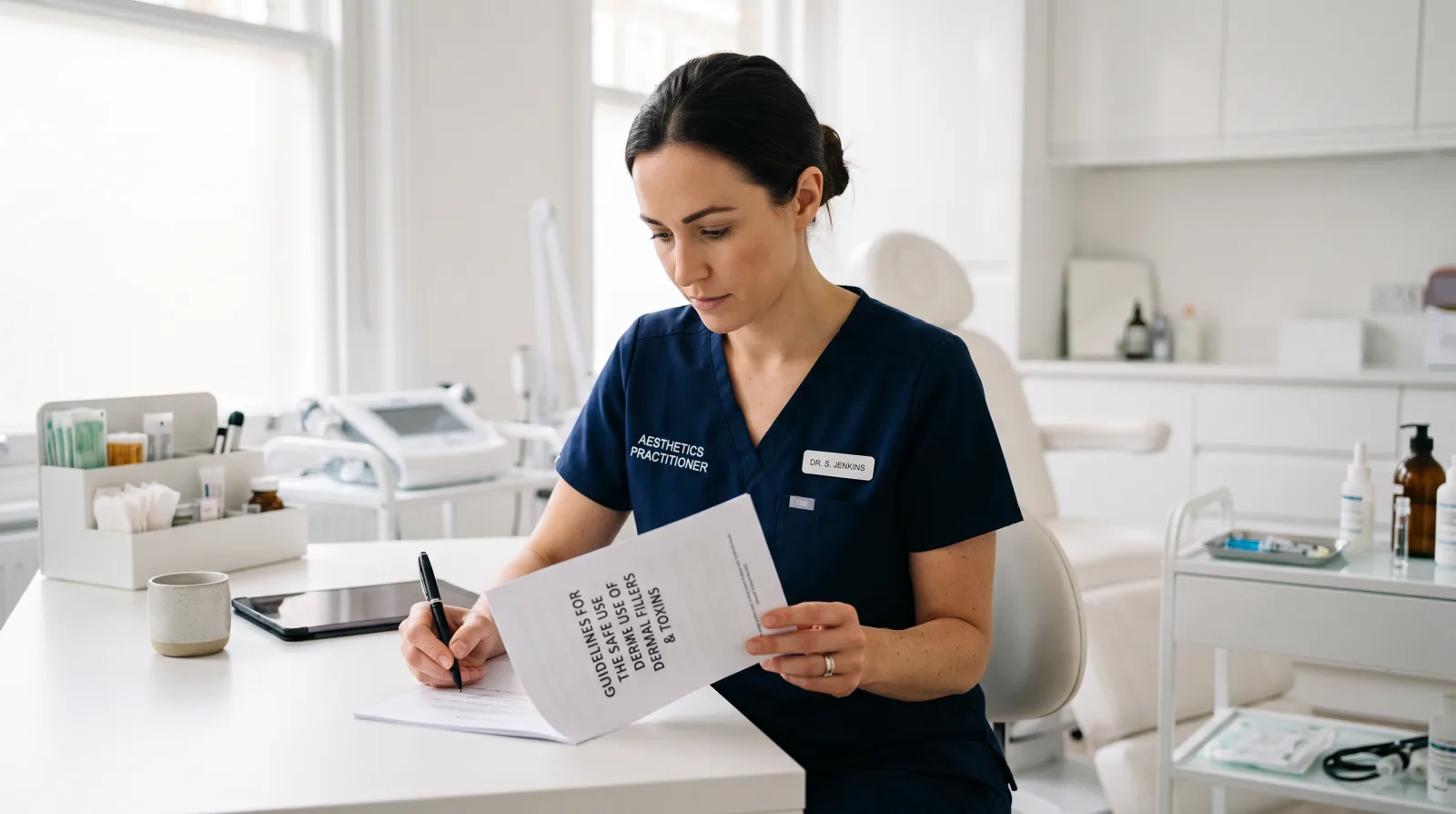
NICE NG198 is the National Institute for Health and Care Excellence guideline on acne vulgaris management, published 25 June 2021 and most recently updated 30 April 2026. It sets the severity bands, the first-line and second-line treatment combinations, and the referral thresholds NHS clinicians work to. For aesthetic practitioners, NG198 is the document that defines what falls inside specialist medical care and what does not.
What NG198 actually is
NG198 is the NICE clinical guideline that covers managing acne vulgaris in primary and specialist care across the NHS in England, with adoption typically extending to Wales, Scotland and Northern Ireland through their respective frameworks. NICE developed the guideline in partnership with the Royal College of Obstetricians and Gynaecologists and the British Association of Dermatologists.
The guidance covers eight scope areas: information and support, skin care, dietary advice, referral pathways for specialist care, treatments (topical, oral and physical), management of relapse, maintenance, and management of acne-related scarring. The most recent update, in April 2026, removed the requirement for two independent healthcare professionals to approve isotretinoin in patients under 18.
For aesthetic practitioners, NG198 is the reference document the NHS treats as authoritative. When a regulator or insurer asks what evidence base a clinic worked from, NG198 is the answer they expect to hear.
The severity bands NG198 sets
NG198 frames acne in three severity bands, which the NICE recommendations chapter defines specifically:
- Mild to moderate. Any number of non-inflammatory lesions (comedones), with up to 34 inflammatory lesions, or up to two nodules.
- Moderate to severe. 35 or more inflammatory lesions, or three or more nodules.
- Severe. Forms resistant to standard therapy, including nodulo-cystic acne, acne conglobata, acne fulminans, or any acne carrying a risk of permanent scarring.
The BAD's acne referral guidance for primary care maps to the same bands and notes that a universally accepted definition of acne severity does not exist. Clinical judgement, accounting for treatment history, scarring, and family factors, sits alongside the lesion count.
For an aesthetic practitioner, the practical read is that anything beyond mild to moderate sits inside medical scope. The presence of three or more nodules, or any sign of scarring or persistent psychological distress, takes the case out of cosmetic-skin territory and into a referral conversation.
The treatment pathway NG198 recommends
NG198 sets specific 12-week first-line combinations.
For any severity:
- Fixed combination topical adapalene with benzoyl peroxide (once daily), or
- Fixed combination topical tretinoin with clindamycin (once daily).
For mild to moderate acne, additionally:
- Fixed combination topical benzoyl peroxide with clindamycin (once daily).
For moderate to severe acne, additionally:
- Topical adapalene with benzoyl peroxide plus oral lymecycline or doxycycline, or
- Topical azelaic acid plus oral lymecycline or doxycycline.
The 12-week course is reviewed at the end of treatment. If response is inadequate, NG198 sets out second-line combinations. To reduce skin irritation from topical retinoids or benzoyl peroxide, the guideline recommends starting with alternate-day or short-contact application and progressing to standard application as tolerated.
When oral antibiotics are used, the recommendation is a 3-month initial course with topical therapy alongside, to ensure optimal treatment without driving antimicrobial resistance. This is the antimicrobial-stewardship constraint that any practitioner outside primary care needs to understand: prolonged antibiotic monotherapy is not in the guideline.
The line between primary care and specialist referral
NG198 is explicit about referral. A patient is referred to a consultant dermatologist-led team or a nationally accredited GP with extended role (GPwER) where any of the following applies:
- Acne fulminans: same-day urgent referral.
- Diagnostic uncertainty, acne conglobata, or nodulo-cystic acne: mandatory referral.
- Mild to moderate acne unresponsive to two completed courses of treatment.
- Moderate to severe acne unresponsive to previous treatment including an oral antibiotic.
- Acne with scarring.
- Acne of any severity contributing to persistent psychological distress or where a mental health disorder is suspected.
The BAD's referral guidance sits alongside this, with the same thresholds and additional notes on isotretinoin pathways. Oral isotretinoin is specialist-only. Intralesional corticosteroids for individual cysts are specialist-only. Severe-acne treatment more broadly is specialist-only.
The NHS public-facing page on acne treatment restates the pathway in plain language: pharmacist for mild acne, GP for moderate/severe acne or treatment failure, dermatologist for severe or scarring acne and isotretinoin candidates.
What this means for an aesthetic practitioner
NG198 defines the medical pathway. An aesthetic practitioner working outside that pathway operates in a narrow band: support for skin barrier and tolerance, post-treatment scar management once the active disease is controlled by medical therapy, and signposting to NHS or specialist care when severity, scarring or psychological distress crosses the referral thresholds.
A few rules apply directly to aesthetic scope:
- Active moderate-to-severe acne is not an aesthetic case. It is a medical case. The right move is referral, with the aesthetic practitioner standing down active treatment until the disease is controlled.
- Antibiotic prescribing for acne sits inside primary care. An aesthetic practitioner who is also an independent prescriber must follow the NG198 antimicrobial-stewardship logic, not invent a private alternative.
- Isotretinoin is specialist-only. This is settled. Any clinic referring a patient towards isotretinoin should be referring them into the consultant-led pathway, not handling it privately outside that pathway.
- Marketing claims must not promise NG198-pathway outcomes. A clinic cannot promise the outcome of a medical pathway it is not delivering. The ASA position on cosmetic claims is the relevant frame here.
The Aesthetics Unlocked Acne Decoded course is built directly against NG198 and the BAD guidance. It teaches the severity bands, the referral thresholds, the boundary between aesthetic scope and medical scope, and the consent and documentation that holds up against a regulator. Practitioners running it leave with a clear NG198-aligned protocol for their clinic, including referral templates and the post-acne scarring scope they can address inside cosmetic practice.
If you also need the broader regulatory frame, the RAG Pathway is the four-week programme that lands practitioners aligned with the eight regulators we teach against before the licensing scheme tightens.
FAQ
Is NICE NG198 mandatory for aesthetic practitioners?
NG198 is the NHS clinical reference. It is not law, but the regulators (CQC, GMC, NMC) treat NICE guidance as the standard a defensible practitioner is expected to know and operate against. An aesthetic practitioner working outside the NG198 pathway needs a clear, documented justification for doing so.
Where does aesthetic practice sit inside NG198?
NG198 covers medical management of active acne. Aesthetic practice picks up around it: barrier support, sensitive-skin care during medical treatment, and post-acne scar management once active disease is controlled. Active moderate-to-severe acne is not an aesthetic case under NG198.
Can an aesthetic practitioner prescribe oral antibiotics for acne?
Only if the practitioner holds independent prescribing rights and is operating inside NG198. The recommendation is a 3-month course with topical therapy alongside, never antibiotic monotherapy, and never beyond the courses NG198 defines. Antimicrobial stewardship is the constraint that disciplines this.
What is the BAD's role alongside NICE?
The British Association of Dermatologists co-developed NG198 with NICE and the RCOG. Its primary-care referral guidance maps to the NG198 severity bands and adds practical notes on referral pathways and isotretinoin.
Does NG198 cover post-acne scarring?
Partially. Acne-related scarring is one of the eight scope areas in NG198, with management directed through the specialist dermatology pathway. Cosmetic scar treatments such as microneedling and fractional laser sit outside NG198 itself but should only be considered once active acne is controlled under the medical pathway.
What changed in the April 2026 update?
NICE removed the requirement for two independent healthcare professionals to approve isotretinoin in patients under 18. The clinical pathway is otherwise unchanged. The severity bands, first-line combinations, and referral thresholds remain as set in 2021.