
Your client comes back six weeks after a course of treatment that worked. The active spots are gone. The skin is calm. But the marks left behind are still there, and she thinks the treatment failed.
It didn't. You're now treating something different. And whether you treat it well comes down to a single question: is it PIH or PIE?
Most practitioners use the words interchangeably. They are not the same thing. They sit at different depths in the skin, they look different under the right light, and they respond to completely different ingredients. Treating one as the other is the most common reason "acne aftermath" protocols stall in clinic.
This post is the short version of the assessment I teach inside Acne Decoded. If you take only one thing from it, take this: never start a sequelae protocol until you know which one you are looking at.
The clinical distinction
Post-inflammatory hyperpigmentation (PIH) is melanin. After an inflammatory episode in the skin, melanocytes overproduce pigment that gets deposited into the epidermis and, in some cases, drops down into the dermis. The mark is brown, tan, dark grey, or sometimes almost black. It is more common, and more stubborn, in Fitzpatrick skin types III through VI. The classic literature on this is the Davis and Callender 2010 review in the Journal of Clinical and Aesthetic Dermatology, which is still the reference text most clinicians cite.
Post-inflammatory erythema (PIE) is vascular. After the inflammation resolves, the dilated capillaries that fed it are slow to retreat. The mark is pink, red, or sometimes purplish. It is more visible in lighter Fitzpatrick types because the contrast against the surrounding skin is greater. Bae-Harboe and Graber's 2013 paper "Easy as PIE" was the first to formally name and describe it as a distinct entity, and it remains the standard reference.
The two can co-exist on the same client. A client with mid-Fitzpatrick skin who has had inflammatory acne for years will often have both, sometimes on the same lesion site.
How to tell them apart in clinic
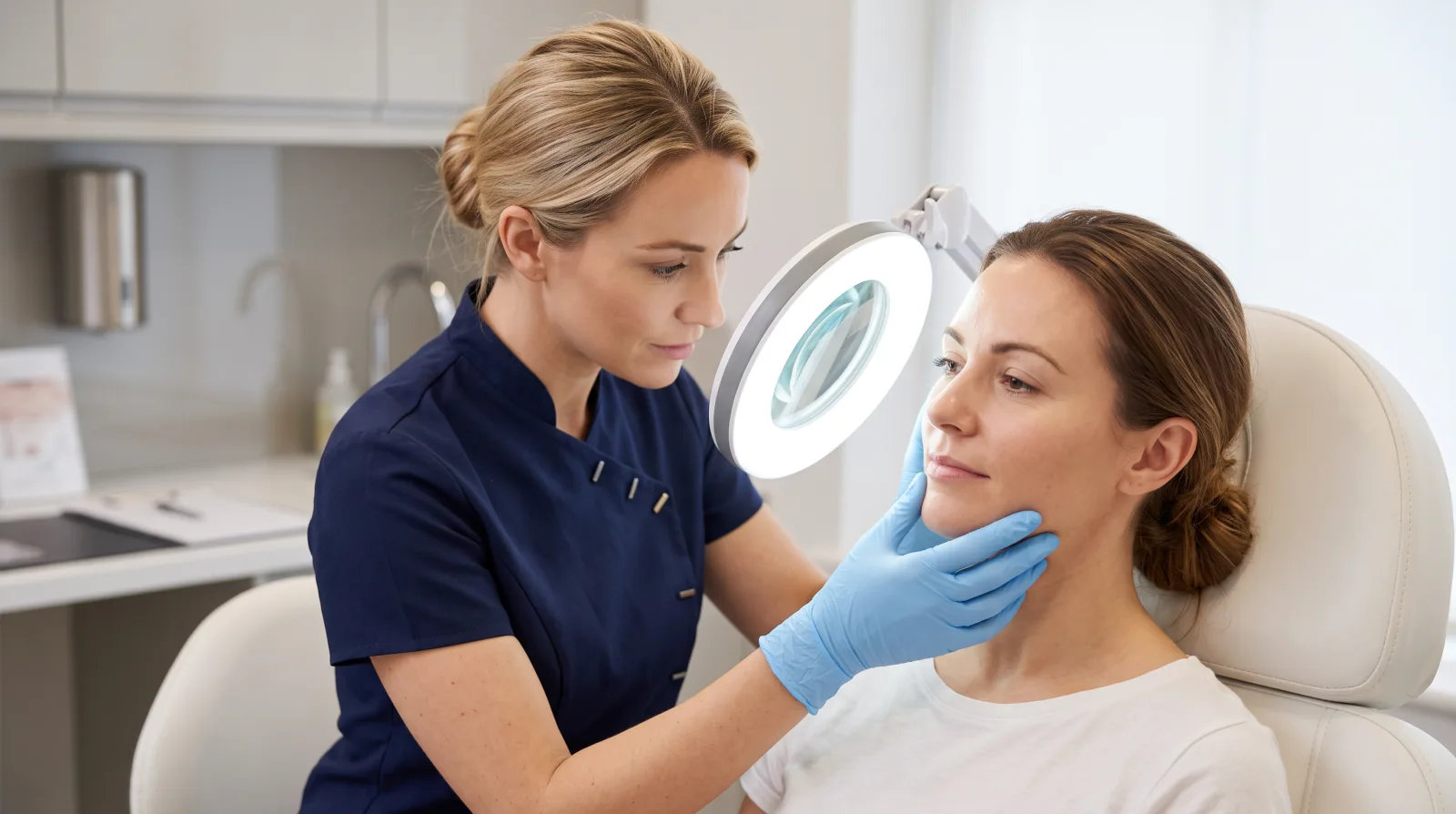
The fastest test is diascopy. Press a clean glass slide or a transparent acrylic spatula firmly against the mark for two to three seconds and watch what happens.
- If the mark blanches (goes pale or disappears under pressure), it is vascular. That is PIE.
- If the mark stays put under pressure, it is pigment. That is PIH.
The second test is lighting. Move the client to north-facing daylight or use a daylight-balanced LED. PIH reads as a flat brown or grey patch with reasonably defined edges. PIE reads as a soft pink wash with edges that fade out into the surrounding skin.
The third test is age of the mark. PIE tends to declare itself within days of an active lesion resolving. PIH can take longer to show up because melanin transfer to keratinocytes is not instantaneous. If the mark is more than three or four weeks old and still pink, it is almost always PIE rather than slow-developing PIH.
If you are still not sure after diascopy, lighting, and timing, document with photography under controlled lighting and revisit at the follow-up. Do not start treating speculatively.
Why each one needs different treatment
This is where the protocol divergence matters.
PIH responds to
- Tyrosinase inhibitors. Azelaic acid (15 to 20 per cent), kojic acid, alpha arbutin, tranexamic acid. These slow melanin synthesis at the source.
- Cell turnover acceleration. Topical retinoids (tretinoin, adapalene), and well-tolerated AHA exfoliation. The aim is to shed pigmented keratinocytes faster than the melanocytes can replace them.
- Daily broad-spectrum SPF. Non-negotiable. UV exposure restimulates the melanocytes you are trying to quieten. Without SPF the protocol does not work, and you will spend twelve weeks running to stand still.
- Time. Even a well-built PIH protocol takes twelve to twenty-four weeks to show meaningful clearance. NICE Clinical Knowledge Summaries on acne vulgaris are explicit that pigment changes are slow to resolve and that the client needs to be told this at the outset.
PIE responds to
- Vascular-targeting interventions. Pulsed dye laser, intense pulsed light with a vascular cut-off filter, KTP. These are device-led, not topical-led, and they sit outside many aesthetic practitioners' scope. Know your referral pathway.
- Anti-inflammatories. Niacinamide (4 to 5 per cent) reduces vessel reactivity. Centella asiatica and oral tranexamic acid have emerging evidence in selected cases.
- Time, with patience. Many PIE marks resolve on their own within six to twelve months without intervention if the underlying acne stays controlled. The risk of over-treating PIE is causing further inflammation and prolonging the very thing you are trying to fix.
The single biggest mistake I see in clinic is using a melanin-targeting protocol on PIE. Hydroquinone, kojic acid, retinoids: none of them touch a vascular mark. The client uses the protocol for three months, sees no change, and concludes that aesthetic treatment doesn't work for her. That is a retention failure, not a science failure.
The framework I teach
Inside the Acne Decoded course, the assessment runs in five steps before any sequelae protocol begins:
- Confirm the active acne is controlled. Treating sequelae on top of ongoing inflammation is treating downstream of the actual problem. Get the acne stable first.
- Diascopy on every visible mark. Document which are PIH and which are PIE. The same client can need two different protocols on different parts of her face.
- Fitzpatrick the client. PIH risk and PIE visibility both shift across skin types. The protocol you would write for a Fitzpatrick II differs from a Fitzpatrick V.
- Set the timeline expectation in writing. Twelve to twenty-four weeks for PIH. Six to twelve months, with possible device referral, for PIE. If the client is not signed up to a realistic timeframe, she will leave at week six.
- Decide what is in your scope and what is a referral. PDL and IPL for PIE are device referrals for many aesthetic practitioners. Knowing the local NHS or specialist pathway and warmly handing the client over is part of the standard of care, not a failure of skill. The British Association of Dermatologists patient information leaflet on acne is a useful handout to send with the referral so the client arrives informed.
When to refer
Refer to a dermatologist or specialist dermatology service when:
- The pigmentation has features outside post-inflammatory change (asymmetric borders, rapid colour change, papular surface). Consider melanocytic lesions, melasma, or other diagnoses.
- The acne itself is severe, scarring, or unresponsive to first-line treatment as defined by NICE Clinical Knowledge Summaries.
- The client has Fitzpatrick V to VI skin and the PIH is extensive. The literature on treatment in skin of colour is more nuanced and the risk of treatment-induced PIH is higher.
- The client is requesting laser or device intervention for PIE that sits outside your scope of practice.
A confident referral is not a loss of the client. It is the move that protects her, and protects your reputation.
Why this matters for your business
Aesthetic practitioners lose acne clients at the sequelae stage, not at the active treatment stage. The active acne usually responds. The marks that get left behind are the part the client photographs in the bathroom mirror and decides whether the journey was worth it.
Get the diagnosis right at the post-treatment review, set the timeline expectation, choose the right protocol, and refer cleanly when needed. That is what turns a single course of treatment into a long-term clinical relationship.
Continue your reading
If you want the full assessment framework, including the photography protocol, the consult script for setting timeline expectations, and the full ingredient-by-ingredient breakdown for each Fitzpatrick band, that is what we cover inside Acne Decoded. The free taster, Free Acne Decoded, walks through the assessment principles before you commit to the full course.
Bernadette Tobin is a Registered Nurse and Independent Nurse Prescriber with an MSc in Advanced Practice (Level 7). She is the founder of Aesthetics Unlocked and a 2026 Educator of the Year Nominee at the Beauty & Aesthetics Awards. She runs Visage Aesthetics in Essex, named Best Non-Surgical Aesthetics Clinic 2026 by the Health, Beauty & Wellness Awards. Verifiable on the NMC public register.