
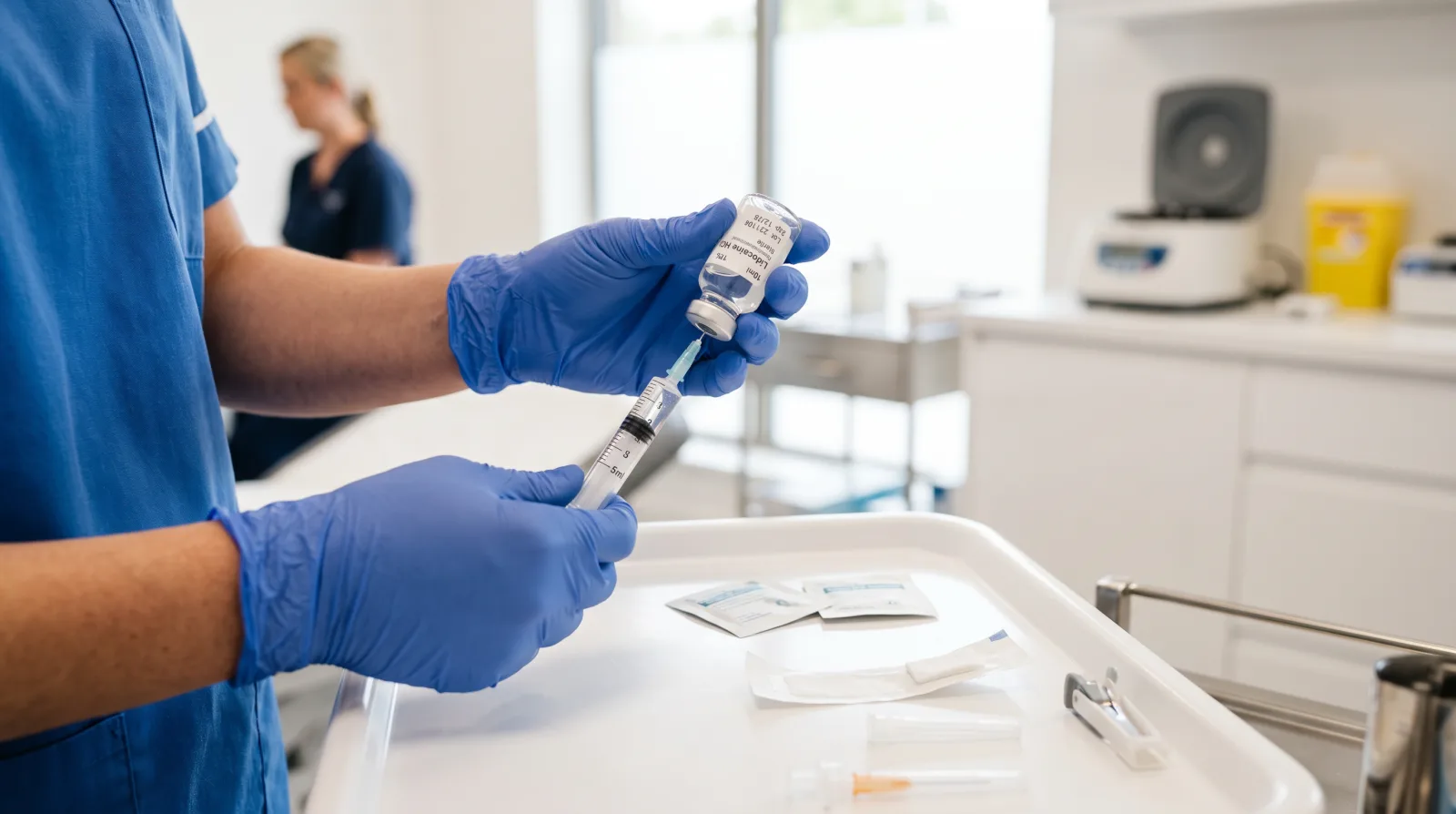
Polynucleotides are long-chain DNA-derived molecules that, when injected intradermally, stimulate collagen synthesis, improve skin hydration, and reduce fine lines through adenosine receptor activation. They produce no immediate volume correction. Instead, they remodel tissue architecture over weeks. The clinical evidence is growing, the safety profile is reassuring, and the quality of current studies is still limited. This is what practitioners need to weigh before incorporating polynucleotides into practice.
What Are Polynucleotides?
Polynucleotides (PN) and polydeoxyribonucleotides (PDRN) are nucleic acid polymers derived from highly purified salmon or trout sperm DNA. In aesthetic medicine, they are administered as intradermal or deep intradermal injections, typically across a course of two to four sessions spaced two to four weeks apart.
The terminology is used inconsistently across the market. PDRN and PN are sometimes treated as synonyms, but they differ in chain length and molecular weight. PDRN preparations tend to have shorter DNA chains. PN products typically carry longer chains and higher molecular weight. Both work through overlapping biological pathways. However, the formulations diverge considerably across commercial products: concentration, chain length, carrier medium, and purification method all vary. Results from one product do not transfer automatically to another. That heterogeneity matters when reading the literature.
Common UK products include Plinest, Nucleofill, and Juvelook. Rejuran, well-established in Korean and Asian markets, has also entered UK practice. These are not equivalent, and practitioners should treat each formulation on the basis of its own clinical data and instructions for use.
How Polynucleotides Work in Skin
The primary mechanism involves activation of adenosine A2A receptors in the dermis. This receptor pathway drives downstream effects including upregulation of vascular endothelial growth factor (VEGF), which promotes neovascularisation, and suppression of pro-inflammatory cytokines including tumour necrosis factor-alpha. The result is a pro-regenerative dermal environment: fibroblast activation, increased extracellular matrix synthesis, and new collagen deposition.
This is mechanistically distinct from hyaluronic acid (HA) fillers. HA provides mechanical volume and viscoelastic support by attracting and retaining water within the dermis. Polynucleotides contribute no mechanical volume. Where HA corrects an immediate deficit, polynucleotides work to restore tissue function over time. The clinical response is gradual, building over four to eight weeks as remodelling progresses.
That distinction matters for both patient selection and consent. A patient seeking correction of deep nasolabial folds or tear trough hollowing needs HA. A patient with diffuse skin quality loss, fine surface lines, and loss of elasticity without significant volume deficit is a better candidate for a regenerative approach.
What the Clinical Research Shows
The most rigorous current synthesis is a systematic review published in the Journal of Cosmetic Dermatology in 2025 by Lampridou and colleagues. The review searched Embase, Medline, and Cochrane for primary studies published between January 2010 and January 2024. Nine studies met inclusion criteria, describing a combined population of 219 patients receiving PN treatment. Study quality was rated as low to moderate using established methodological tools.
The findings are encouraging but measured. Polynucleotide injections produced statistically significant improvements in wrinkle depth, skin texture, and elasticity across multiple included studies. Patient satisfaction ranged from moderate to high. Adverse events were mild and transient: erythema, oedema, ecchymosis, and occasional nodularity at injection sites. No serious systemic adverse events were reported across the studies reviewed.
The review concluded that while the potential of polynucleotides is significant, the current evidence base is characterised by small sample sizes, heterogeneous injection protocols, and short follow-up periods. The authors called for rigorous, well-designed randomised controlled trials before firm clinical recommendations can be made.
A 2024 review in the International Journal of Molecular Sciences reached consistent conclusions. Examining polynucleotide use in facial rejuvenation and acne scar applications, the review documented improvements in skin hydration, elasticity, and wrinkle depth across published series, while identifying the same limitations: protocol variability and the absence of standardised outcome measures.
The two reviews agree on the central point. Polynucleotides work. The mechanism is biologically plausible, the observed outcomes align with that mechanism, and the safety signal is favourable. What the evidence does not yet supply is a clear answer on which protocol, which product, and which patient population produces the best result. That is a genuine gap, not grounds for scepticism about the treatment class itself.
Specific Applications the Literature Supports
Within the broader signal, certain applications appear with most consistency across published studies.
Periorbital rejuvenation. The thin skin of the lower eyelid and crow's feet area responds well to polynucleotide injections in published series. Studies examining this zone report improvements in fine line depth and overall periorbital appearance that persist at four-to-eight-week follow-up. The anatomy makes HA fillers higher risk in this area; polynucleotides offer a regenerative alternative without the same occlusion risk.
General facial skin quality. Diffuse improvement in skin texture, hydration, and surface line depth is the most commonly reported outcome across studies. This makes polynucleotides a reasonable adjunct or alternative to HA skin boosters where the primary goal is skin quality rather than volume.
Acne scarring. Early-stage evidence suggests polynucleotides may support scar remodelling through their fibroblast-stimulating mechanism. Studies in this area are small and methodologically heterogeneous, but the biological rationale is sound. Acne Decoded covers the clinical framework for approaching acne and its sequelae, including the evidence base for different treatment modalities.
Combination with energy-based devices. Studies examining polynucleotides used alongside radiofrequency microneedling consistently report greater improvements in skin quality than RF microneedling alone. The mechanism is synergistic: energy-based tissue stimulation followed by biological scaffolding and growth factor activation accelerates the remodelling response. These findings are early-stage, but the rationale is well-grounded.
Polynucleotides vs Hyaluronic Acid and Skin Boosters
Practitioners are frequently asked to position polynucleotides relative to HA fillers and HA skin boosters. The answer depends on the clinical objective.
For volume correction, polynucleotides are not a substitute. They produce no structural support and no volumising effect. HA fillers remain the appropriate choice where tissue deficit or structural correction is the goal.
For skin quality improvement, polynucleotides and HA skin boosters address overlapping indications through different mechanisms. HA skin boosters hydrate and plump by adding a water-binding matrix. Polynucleotides stimulate the skin's own repair processes. The choice between them is not necessarily binary. Some protocols use them in combination or sequence, allowing an immediate HA hydration response while the regenerative remodelling process builds over following weeks. That combined approach has not been formally studied, but it reflects current clinical practice patterns in markets where polynucleotides are more established.
From a risk profile perspective, polynucleotides do not carry the risk of vascular occlusion that applies to HA injectables. That risk is small with HA products but real, and it has driven interest in non-HA injectables in anatomically sensitive zones. Polynucleotides are not without injection-related risks, and they require the same standard of injection training and anatomical knowledge as any other injectable treatment. The absence of vascular occlusion risk should not be read as an absence of risk.
The Regulatory Position in the UK
Polynucleotide products in UK clinical use are classified as Class III medical devices. Class III is the highest-risk device classification under the UK Medical Devices Regulations 2002, applying to devices that are implanted or have prolonged contact with the body, or that introduce substances into the body. Intradermal injectable products fall within this classification.
CE-marked Class III devices are currently recognised in Great Britain under post-Brexit transitional arrangements, while the MHRA develops its updated regulatory framework for medical devices. The MHRA has extended the transitional recognition period for CE-marked devices multiple times; practitioners should monitor MHRA guidance directly rather than relying on secondary summaries, as the transition timetable has changed.
What this means in practice: practitioners should confirm that any polynucleotide product they use holds current CE marking, can produce a declaration of conformity from a notified body, and has clinical evidence supporting the specific application and indication. Products that arrive without these documents, or that are marketed with claims unsupported by notified body assessment, carry regulatory and clinical risk.
The UK cosmetic licensing scheme, enacted under the Health and Care Act 2022 and applying from July 2026, requires practitioners in England who perform cosmetic procedures, including injectable treatments, to hold an appropriate licence. Polynucleotide injections fall within that scope. If you are not yet across the licensing requirements, the RAG Pathway takes practitioners through the regulatory framework in detail, from the Health and Care Act to the MHRA device landscape and the JCCP standards that run alongside both.
What This Means for Clinical Practice
The clinical picture at the start of 2026 is clear enough to act on, and clear enough to require honesty about its limits.
Polynucleotide injectables are a legitimate, evidence-supported treatment class with a favourable safety profile and a plausible biological mechanism. The evidence supports their use for skin quality improvement in appropriately selected patients. It does not support confident claims about optimal dosing, session intervals, or product superiority. Practitioners adopting polynucleotides should approach them as a promising but evolving modality, not a fully characterised protocol.
Informed consent requires particular care. Patients should understand that visible results take weeks, that the course typically requires multiple sessions, and that the evidence base, while growing, has not yet generated the level of certainty attached to well-established treatments. These are not reasons to withhold the treatment. They are reasons to have an accurate conversation before beginning it.
Product selection also requires care. The polynucleotide market is expanding rapidly, and not all products have equivalent clinical data. Chain length, concentration, and purity differ across formulations in ways that have not been formally compared in head-to-head trials. Practitioners should not assume that evidence generated for one product applies to another carrying the same ingredient name.
For practitioners who want a structured approach to staying current with both the clinical landscape and the regulatory environment in aesthetics, the RAG Pathway is the four-week programme that maps the territory: from the Health and Care Act through to JCCP standards, MHRA device regulation, and the evidence frameworks that underpin clinical decision-making. The free two-day introduction is open now.
FAQ
Are polynucleotides the same as PDRN? Not exactly. PDRN (polydeoxyribonucleotide) and PN (polynucleotide) both derive from purified fish sperm DNA and share a biological mechanism through adenosine A2A receptor activation. They differ in chain length and molecular weight: PDRN tends toward shorter chains, PN toward longer. Both categories are marketed under multiple product names. Formulations should not be assumed to be clinically equivalent.
How long before results are visible? Unlike hyaluronic acid fillers, polynucleotides produce no immediate volumising effect. Clinical improvements in skin texture, hydration, and fine lines typically develop over four to eight weeks as tissue remodelling progresses. Most protocols involve two to four sessions spaced two to four weeks apart. Patients should be counselled clearly about this timeline before treatment.
What adverse effects have been reported? Across the published literature reviewed by Lampridou et al. (2025), adverse events are mild and transient: erythema, oedema, ecchymosis, and occasional nodularity at injection sites. No serious systemic adverse events were reported. The adverse event profile compares favourably with hyaluronic acid injectables, which carry a small additional risk of vascular occlusion not applicable to polynucleotide products.
Are polynucleotides regulated in the UK? Yes. Injectable polynucleotide products are classified as Class III medical devices under UK and EU regulations, the highest-risk device category. Products such as Plinest, Nucleofill, and Juvelook carry CE marking recognised under MHRA's post-Brexit transitional arrangements. Practitioners should confirm CE marking and notified body certification for any product they use and monitor MHRA guidance as the UK device regulatory framework continues to evolve.
Do polynucleotide injections fall under the July 2026 licensing scheme in England? Yes. Injectable cosmetic procedures, including polynucleotide treatments, fall within the scope of the licensing scheme introduced by the Health and Care Act 2022, applying in England from July 2026. Practitioners in England administering these treatments must hold an appropriate licence. The RAG Pathway covers the full licensing framework for aesthetic practitioners.
Is there a best protocol for polynucleotide treatment? No standardised protocol has been established in the peer-reviewed literature. Published studies have used varying injection techniques, session intervals, product concentrations, and anatomical zones. Until higher-quality evidence produces clear clinical benchmarks, practitioners should follow product-specific instructions for use and manufacturer-trained protocols, and should not extrapolate protocol details from studies using different formulations.