
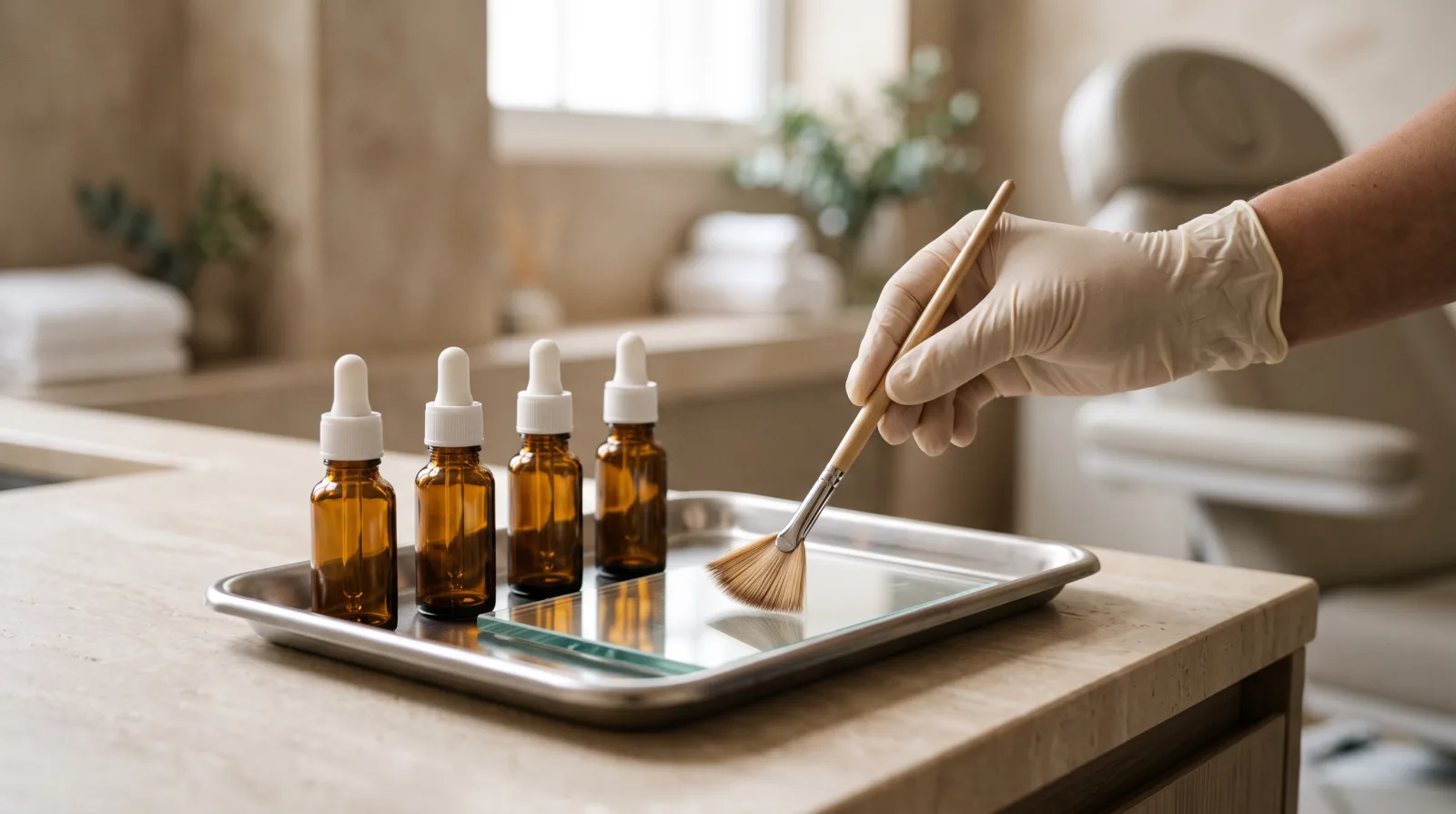
Glycolic acid peels reduce corneocyte cohesion, accelerate epidermal turnover, and stimulate fibroblast activity at the dermal level. The peer-reviewed evidence supports their use for mild-to-moderate acne, post-inflammatory hyperpigmentation, and photoaged skin. Professional concentrations range from 20 to 70 percent, with pH and contact time determining depth of effect.
How glycolic acid peels work
Glycolic acid is an alpha-hydroxy acid (AHA) derived from sugar cane. It has the smallest molecular weight of the AHAs, which gives it stronger skin penetration compared to lactic or mandelic acid. At clinical concentrations, it disrupts the ionic bonds holding corneocytes together in the upper epidermis, producing controlled desquamation.
Beyond exfoliation, the literature documents downstream effects: increased dermal fibroblast activity, upregulation of collagen I and III synthesis, and reduced melanin transfer between melanocytes and keratinocytes. These mechanisms explain the clinical utility across three distinct conditions.
At concentrations above 10 percent with a pH below 3.5, the mechanism shifts from cosmetic exfoliation to controlled chemical injury. Professional peels in this range require correct neutralisation, careful timing, and post-peel care. This is also the regulatory threshold in UK law separating an over-the-counter cosmetic from a professional-use peel.
The evidence for acne and acne scarring
The evidence base for glycolic acid in acne is well established. A JAAD review of superficial and medium-depth peeling identifies glycolic acid as a first-line agent for comedonal and mild-to-moderate inflammatory acne, with a favourable tolerability profile across Fitzpatrick types I to III.
The benefit in acne is mechanistically threefold. Follicular hyperkeratinisation is reduced, addressing the root cause of comedone formation. Surface biofilm is disrupted. Post-inflammatory marks clear faster via accelerated epidermal turnover.
Comparative studies have found glycolic acid peels (30–70% concentration) broadly equivalent to salicylic acid (BHA) peels for inflammatory acne lesion counts, with glycolic showing a clinical advantage where concurrent post-inflammatory hyperpigmentation is present. For atrophic acne scarring, the peer-reviewed literature on chemical peels in skin disorders documents that serial sessions, typically four to six at two-to-four-week intervals, produce measurable improvement in scar depth and surface texture.
Practitioners building acne skincare protocols will find this evidence useful alongside the clinical approach covered in Acne Decoded.
The evidence for post-inflammatory hyperpigmentation
For post-inflammatory hyperpigmentation (PIH), glycolic acid peels have a clear mechanism: they accelerate epidermal cell turnover, moving melanin-loaded keratinocytes out of the epidermis faster than natural clearance. Combined with a daily SPF protocol, this reduces surface-visible PIH over a course of treatment.
The literature distinguishes between epidermal and dermal PIH. Glycolic acid peels have the strongest evidence for the epidermal variant, where melanin sits in the basal and spinous layers. Dermal PIH, where pigment has migrated below the dermal-epidermal junction, responds more slowly and less predictably to superficial peels.
Knowing which variant a patient presents with shapes the treatment decision. The distinction between PIH and PIE in post-acne marks is directly relevant clinical context here.
For melasma, series data suggest glycolic acid peels can produce visible improvement, but rebound following UV exposure is well documented. Peels alone are not a standalone protocol for melasma. Patients require comprehensive sun protection management before and between sessions.
Darker skin types: where the evidence diverges
Fitzpatrick skin types IV to VI require modified protocols. The same inflammatory cascade that drives exfoliation can trigger paradoxical post-inflammatory hyperpigmentation in darker skin types, particularly at higher concentrations or with prolonged contact time.
The evidence-based position is that lower concentrations (20–35%), shorter contact times, and a priming phase are standard practice for this patient group. Priming with a depigmenting agent for four to six weeks before the first peel is supported by the evidence as a way to reduce PIH risk. The clinical evidence for azelaic acid and niacinamide are relevant here: both are well-evidenced for use in pre-peel priming.
Practitioners working with more diverse skin types should hold specific training in managing Fitzpatrick IV-VI presentations before offering chemical peels.
The UK regulatory framework for AHAs
Post-Brexit, the UK Cosmetics Regulation (retained from EU Regulation 1223/2009) governs AHA concentrations in consumer cosmetic products. Products at or below 10% AHA with a pH at or above 3.5 may be sold over the counter and must carry a sun protection advisory on-pack.
Above this threshold, products are classified as professional-use cosmetics. Concentrations up to 70% are used in clinical practice without a specific medical device classification, provided no medical claim is made. Practitioners should source from professional suppliers whose formulations comply with UK cosmetics legislation.
The JCCP includes chemical peels within the scope of non-surgical cosmetic procedures. Registered practitioners are expected to demonstrate appropriate training competency before offering peels. As the licensing framework for aesthetic practice develops, documented training and clinical protocols become standard professional requirements, not optional additions.
Clinical contraindications practitioners should know
Several contraindications are well established in the peer-reviewed literature and should form part of every pre-treatment assessment:
- Active isotretinoin use: peels are contraindicated during isotretinoin therapy and for a standard washout period of 6 to 12 months afterward. Impaired barrier function during treatment increases the risk of abnormal post-peel healing, including prolonged erythema and scarring.
- Active herpes simplex lesions: peeling can trigger viral reactivation. Prophylactic antiviral cover is standard practice before medium-depth peels in patients with a history of orofacial herpes.
- Compromised skin barrier: acute eczema, active rosacea, or significantly inflamed skin are relative contraindications for higher-concentration peels.
- Recent ablative procedures: timing relative to laser or other resurfacing treatments requires clinical judgement and documented reasoning.
Post-peel sun protection is load-bearing for outcomes. Evidence for photosensitivity following AHA peels is consistent across the literature. Establishing patient sun-protection habits before starting a peel course is standard practice, not an optional recommendation.
If you are building a post-inflammatory hyperpigmentation protocol into your clinical offering, Hyperpigmentation Decoded covers the full clinical picture and evidence-based management approaches.
FAQ
Are glycolic acid peels classed as medical procedures in the UK?
At concentrations used in professional practice, glycolic acid peels are classified as cosmetic procedures under UK cosmetics legislation, not as medical procedures. They fall within the JCCP's non-surgical cosmetic procedure scope, and practitioners are expected to hold appropriate training competency before offering them.
What concentration is used in professional glycolic acid peels?
Professional peels range from 20 to 70 percent. Superficial peels at 20 to 35 percent are the standard starting point for a clinical series. Higher concentrations are used for more pronounced resurfacing in appropriate patients, with shorter contact times and careful observation throughout. Concentration alone does not determine depth of effect: pH, contact time, skin preparation, and Fitzpatrick type all influence the outcome.
Can glycolic acid peels be used on darker skin types?
Yes, with protocol modification. Evidence supports lower concentrations (20–35%), shorter contact times, and a structured priming phase in Fitzpatrick types IV to VI. The risk of paradoxical post-inflammatory hyperpigmentation is higher in darker skin, and this should be addressed directly in pre-treatment consultation and documented in the clinical record.
How does glycolic acid compare to salicylic acid for acne?
Both are well-evidenced for acne. Salicylic acid is lipophilic, giving it stronger follicular penetration, which suits comedonal and sebum-driven presentations. Glycolic acid has a clinical advantage where concurrent PIH is the priority alongside active acne. The choice is guided by clinical presentation, patient history, and Fitzpatrick type.
Is isotretinoin a contraindication for glycolic acid peels?
Active isotretinoin use is a contraindication, and the standard washout period before peeling is 6 to 12 months. Impaired barrier function and reduced sebaceous activity during treatment increase the risk of abnormal post-peel healing. This contraindication applies across all peeling agents.